Measured report · 03
Can a citation-first RAG service clear one million requests at low latency?
We exercised a Go retrieval API through a public GCP load balancer into Cloud Run and Cloud SQL, retained every failed stage, and priced the measured allocation separately from the production baseline.
1,000,000
successful responses
976.8 RPS
sustained throughput
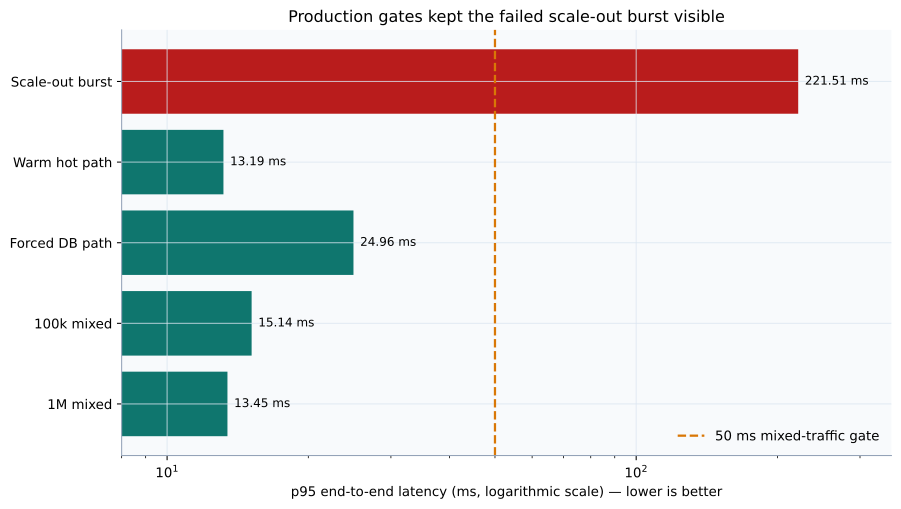
13.45 ms
end-to-end p95
0
HTTP errors
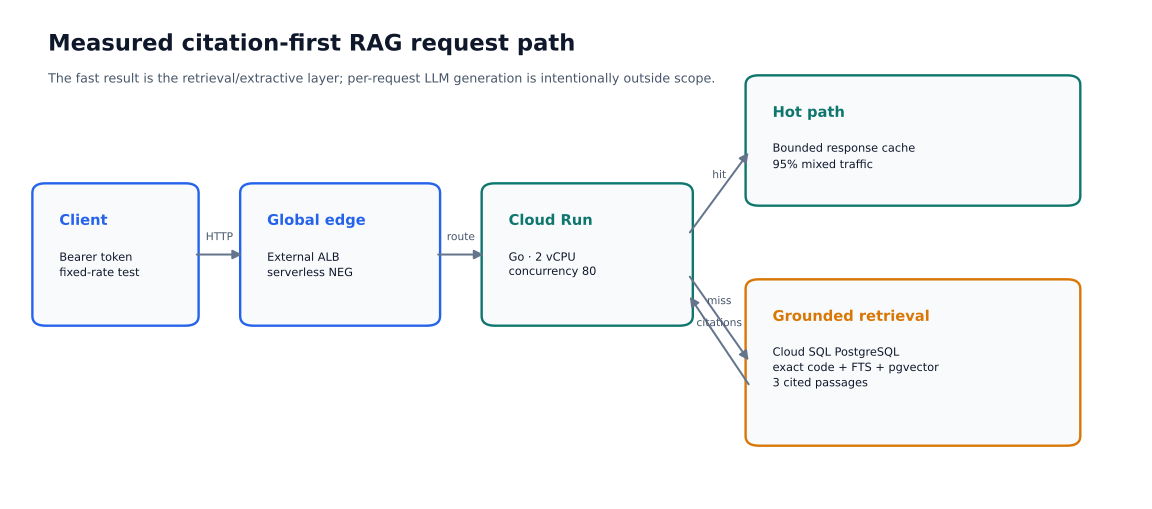
The final mixed run completed one million attempts in 17.1 minutes with 94.97% cache hits. Five percent of traffic deliberately bypassed the cache, so Cloud SQL remained in the measured path.
Cloud Monitoring counted the same one million requests. The service peaked at 5 active instances while Cloud SQL averaged 11.2% CPU utilization.
Request path
A narrow production wedge for field service
Stable manufacturer fault codes take an exact-match lane; broader questions fall through to PostgreSQL full-text and pgvector retrieval.
Gates before scale
Fast retrieval was rejected until it found the right source
The first ranker was fast but recovered the expected synthetic source in the top three only 33.8% of the time.
FAILED · HYBRID RRF V1
33.8%
recall@3 across 500 deterministic queries
PASSED · EXACT CODE + HYBRID
100%
recall@1 and recall@3 on the same query construction
The corpus is deterministic and synthetic: 20,000 troubleshooting chunks with unique source IDs and fault codes. The result proves source recovery for this test construction, not maintenance safety, semantic answer quality or field accuracy.
Tail latency
The failed 1,000-RPS burst stays in the chart
A first burst scaled into cold per-instance caches and reached 221.51 ms p95. The immediate warm repeat and final mixed run passed.
Cost boundary
$0.85 marginal upper bound per million
Measured Cloud Run allocation, request charges, response-body load-balancer processing and North America internet egress. Free tier and discounts are excluded; request-header bytes are not captured.
$239.46
1M requests / month
$239.46 per million
$242.86
5M requests / month
$48.57 per million
$281.17
50M requests / month
$5.62 per million
Production model
The database baseline matters more than request volume
A regional-HA Cloud SQL database, one global forwarding rule and one warm Cloud Run instance total $238.61 per month before traffic.
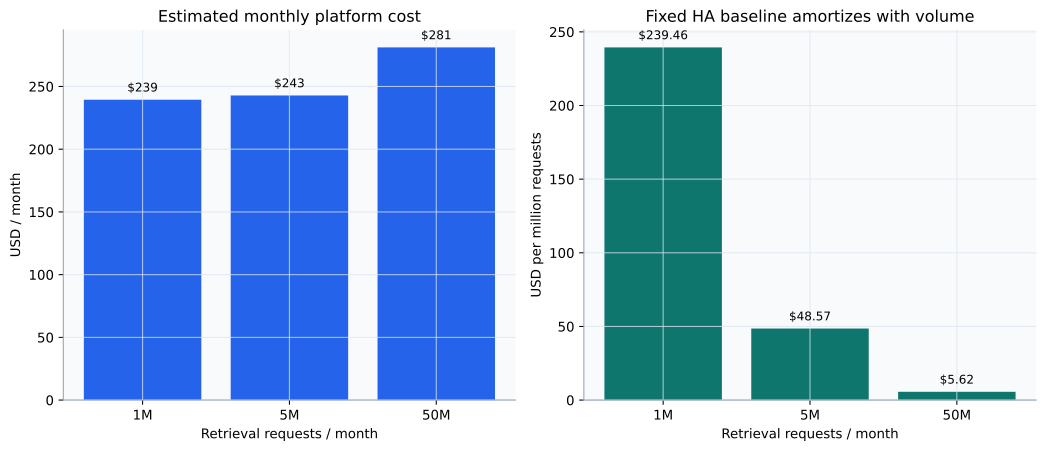
At five million retrieval questions per month the modeled platform total is $242.86. That figure excludes LLM inference, ingestion, observability retention, support labour, taxes and any enterprise resilience work beyond the stated baseline.
Download evidence
Raw results, method and reproduction commands
No email gate. The failed ranker, edge propagation, cache warmup and client-timeout runs are retained beside the passing results.
Have repetitive, citation-sensitive service questions? Start by measuring retrieval quality on your actual documents and escalation rules.
Plan a production RAG gate